How Whitewater Parks Prevent Erosion
Slowing Current and Redirecting Water Volume
Preventing Erosion, Farmers Accidentally Built the First Whitewater Parks
Hydrolaterals Are Already Used in Costa Rica
The Science Behind Hydrolaterals
Why Whitewater Parks Work the Same Way
Preventing Erosion, Farmers Accidentally Built the First Whitewater Parks
Long before recreation was involved,
farmers created the first whitewater parks
– unintentionally – while
solving erosion problems.
Hydrolaterals do two things:
slow water velocity
and
redirect flow away from vulnerable banks.
By implementing hydrolaterals, farmers mitigate erosion.
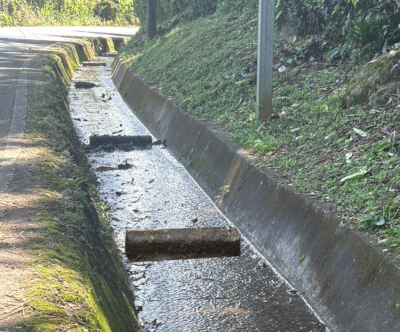
Hydrolaterals Are Already Used in Costa Rica
In Costa Rica,
hydrolaterals are already standard infrastructure.
The Ministry of Public Transportation
(MOPT) installs hydrolaterals inside concrete drainage ditches
that run alongside mountain roads.
As rainfall rushes downhill,
these structures reduce water velocity,
preventing fast-moving runoff from
escaping the ditch
and washing across roadways, especially on curves.
Erosion is the result of three interacting factors:
contact with water, the velocity of the water, and the volume of water.
Hydrolaterals reduce erosion by
forcing water to expend energy climbing over a structure,
which slows its speed.
At the same time,
hydrolaterals push water
volume toward the center of the channel,
away from the banks
where erosion
causes the most damage.
A Farmer's Hydrolaterals and MOPT's Hydrolaterals and a Whitewater Park's Hydrolaterals all Work the Same Way
A whitewater park
is
no different in concept from a
farmer’s hydrolateral or
MOPT’s roadside structures.
The engineered features
slow the water of the river and
concentrate flow toward the center,
and protecting the river banks.
For example, the
first whitewater park in Colorado
was a
single wave in a concrete-lined irrigation ditch
near Montrose, CO.
While
Colorado now has almost 15 whitewater parks,
the Uncompagre Diversion Ditch still the
largest wave in the state!
Economic Benefits of a Whitewater Park
Whitewater parks in the United States and Europe have demonstrated significant economic benefits for the municipalities that host them. Here are several case studies and key points that illustrate these advantages:
1. Whitewater Park in Salida, Colorado
Since the opening of the whitewater park in Salida, CO in the year 2000, the city has experienced significant growth in housing units and an increase in social capital. The park has become a key recreational hub, boosting tourism and driving economic development in the region. (runofriver.org)
2. Whitewater Park in Durango, Colorado
The whitewater park on the Lower Animas River in Durango contributes approximately $18 million (921,600,000 colones) annually to the local economy. This impact comes from both direct visitor spending and the attraction of events that bring participants and spectators to the area. (hcn.org)
3. Whitewater Park in Golden, Colorado
A study of the Clear Creek Whitewater Park in Golden estimated its annual value, based on boater spending, between $1.4 million and $2 million (716,800,000 and 1,024,000,000 colones). The park has also improved the city's image, attracting outdoor enthusiasts and benefiting local businesses. (garivers.org)
4. Whitewater Park in Fort Collins, Colorado
A 2010 evaluation of a proposed whitewater park in Fort Collins indicated potential economic benefits, including an increase in visits and spending in the local area. The park was projected to attract both residents and tourists, contributing to the city's economy. (watercenter.colostate.edu)
5. U.S. National Whitewater Center
Although it is not located in Colorado, the U.S. National Whitewater Center in Charlotte, North Carolina, serves as a relevant example. The center attracts more than 700,000 visitors annually and has an estimated economic impact of $37 million (18,994,000,000 colones) in the region. It employs nearly 500 people during peak season, demonstrating the substantial economic benefits these facilities can offer. (s2odesign.com)
6. Recreational In-Channel Diversions (RICD) in Colorado
Colorado's legal framework for RICDs helps protect investments in whitewater parks by ensuring water rights for recreational use. This legal protection supports the economic benefits associated with these parks, as they keep water in the river channel, are non-consumptive, and help maintain healthy river ecosystems. (eponline.com)
7. Economic Impact of River Recreation in Durango
A 2006 report on the economic impacts of whitewater recreation in Durango highlighted that commercial river use contributed significantly to the local economy, with direct commercial rafting expenditures estimated at more than $5.5 million (2,816,000,000 colones), leading to a total economic impact exceeding $14 million (7,168,000,000 colones). (durangoco.gov)
8. Whitewater Parks as Drought-Resistant Attractions
Whitewater parks have been identified as valuable assets during drought conditions, as they can maintain consistent water flows for recreational use. This reliability makes them attractive destinations even during periods of water scarcity, supporting local economies when other water-based activities may be limited. (hcn.org)
9. Economic Benefits of Conserved Rivers
Studies have shown that conserved rivers with recreational opportunities, such as whitewater parks, provide substantial economic benefits to local communities. These benefits include an increase in tourism, higher property values, and an improved quality of life, all contributing to economic development. (americanwhitewater.org
Social Benefits of a Whitewater Park for Healthy Community Interaction
Key Points for the Development of a Whitewater Park:
1. Economic Growth: Whitewater parks attract tourists, increasing spending at local businesses such as restaurants, hotels, and retail shops.
2. Job Creation: The construction and operation of these parks create employment opportunities both directly within the park and indirectly in the surrounding community.
3. Community Development: These parks serve as recreational hubs, improving residents' quality of life and fostering community engagement.
4. Environmental Benefits: When properly designed, parks can contribute to river conservation efforts, maintaining ecological health while providing recreational opportunities.
5. Year-Round Attraction: With the right design, whitewater parks can offer activities throughout the year, providing continuous economic benefits regardless of the season.
Why the Pejivalle River?
The Pejivalle River is an ideal location for a whitewater park because:
1. The Pejivalle River has no dam, meaning the water is clean.
2. The Pejivalle has a consistent water volume year-round to sustain a whitewater park.
3. The river flows through a community with the necessary amenities and infrastructure to support a thriving tourism industry.
4. The Pejivalle River has a repairable area of appropriate size for a whitewater park.
Compare:
The Salida, Colorado Whitewater Park is 400 meters long.
The Gunnison, Colorado Whitewater Park is 350 meters long.
The Golden, Colorado Whitewater Park is 300 meters long.
The Fort Collins, Colorado Whitewater Park is 200 meters long.
The Pejivalle, Costa Rica Whitewater Park would be 150 meters long.
Why Costa Rica?
There are more than 60 whitewater parks in the United States.
There are zero whitewater parks in Costa Rica because there are zero whitewater parks in Central America.
Unlike the rivers in the United States, Costa Rica’s rivers never dry up and never freeze.
So while whitewater parks in the U.S. generate revenue for municipalities only 6 to 8 months a year, a whitewater park in Costa Rica will attract tourists year-round.